

Technical professionals often spend months solving problems that are invisible to the rest of the business. Then, in one meeting, they have to explain the issue to people who may not know the architecture, code, data flow, platform, security model, or technical constraints behind the work. That is not easy.
The mistake is assuming the goal is to teach executives the full technical system. Usually, it is not. Executives need enough information to make a decision about risk, budget, timing, customers, priorities, and trade-offs. Your role is to translate complexity into decision-ready language.
Explain the consequence before the mechanism. Start with what the issue means for the business, then add only the technical detail needed to support the decision.
Why technical explanations can go wrong
Technical experts and executives often look at the same problem from different angles. A technical team may focus on systems, dependencies, architecture, performance, security, and implementation. Executives may focus on revenue, customer experience, risk, compliance, resources, and strategic timing. Neither view is wrong. They are simply solving different parts of the same problem.
Trouble starts when the technical explanation stays inside the technical world. If you begin with acronyms, frameworks, databases, APIs, load balancing, replication, or code-level details, the executive may not know where to place the information. They may understand that the issue sounds serious, but not what decision they are being asked to make.
A clearer approach is to start with the decision context: customer impact, operational risk, cost, time, opportunity, or reputational consequence. Once the listener understands why the issue matters, the technical explanation has somewhere to land.
How to avoid sounding condescending
Most people do not intend to sound condescending. The problem is usually tone, phrasing, or assumptions. Sentences such as "It is actually simple", "You probably will not understand the technical side", or "Let me dumb this down" create a status gap. Even if you mean well, the listener may hear, "I am the expert and you are behind."
Respectful technical communication treats the executive as a decision partner, not a student. You can say, "The technical detail underneath this is complex, so I will keep the focus on the business impact and the options." That sentence protects accuracy without insulting anyone.
A useful phrase: "The short version is this: here is the impact, here are the options, and here is what I recommend."
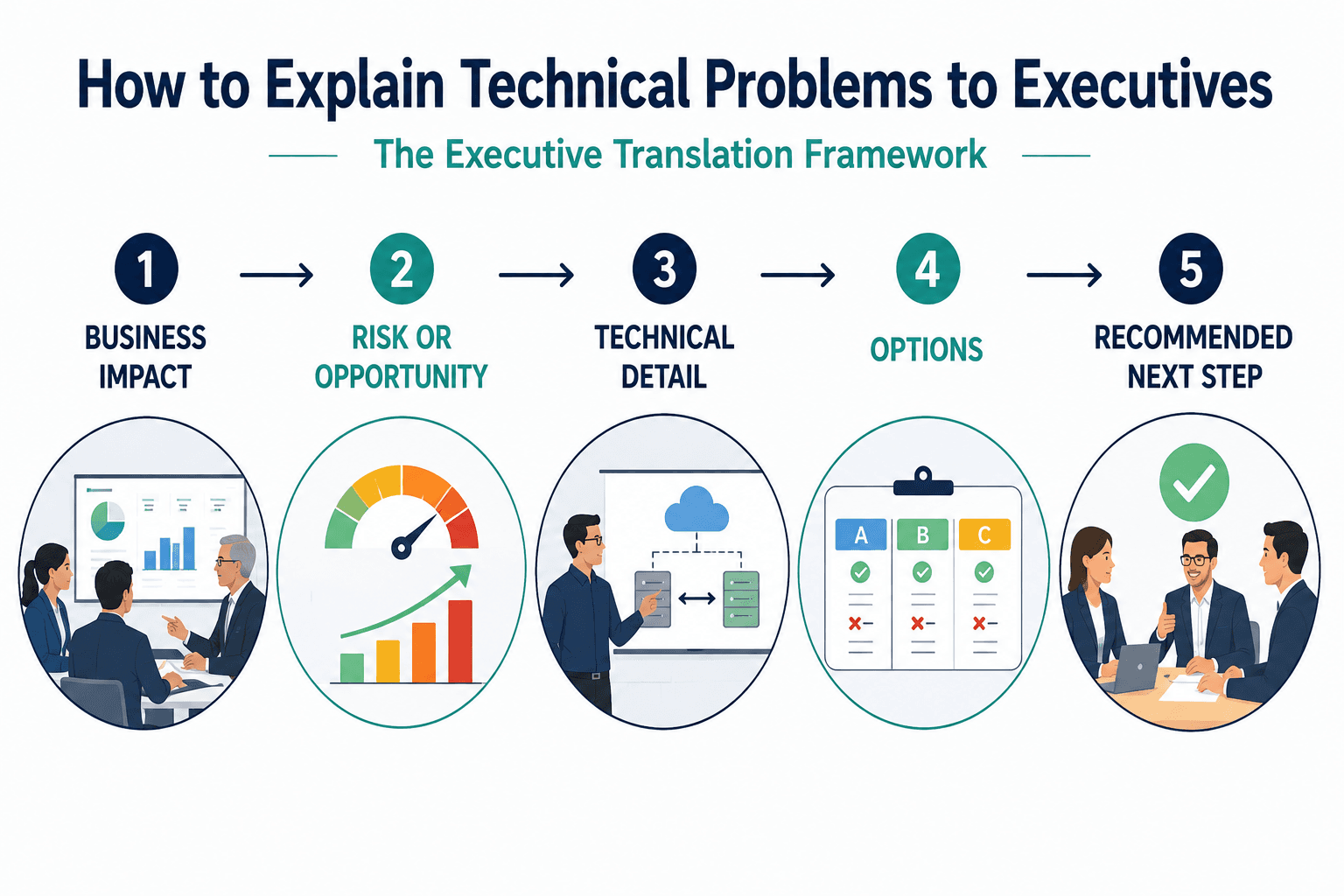
Use the executive translation framework
Before you explain the technology, decide what level of detail the conversation needs. If the executive is choosing a budget, they need cost, risk, benefit, and urgency. If they are choosing a timeline, they need dependencies and trade-offs. If they are responding to a customer issue, they need impact, confidence, and next steps.
- Start with the business impact.
- Explain the risk or opportunity.
- Give only the technical detail needed for the decision.
- Offer realistic options.
- Recommend the next step.
This structure keeps the conversation practical. Instead of saying, "The service has an API version conflict", you might say, "Some customers may experience login failures during busy periods. The cause is a mismatch between two systems that need to communicate. We can apply a short-term fix today and plan a permanent upgrade next month."
Real workplace examples
Explaining a cybersecurity issue
Situation: A senior executive asks why the security team needs budget for a tool they do not personally understand.
Less effective: "The endpoint detection platform identified lateral movement attempts across internal systems."
Better: "We found suspicious activity that could expose customer information if it is not contained. The tool helps us detect and stop that movement earlier, before the risk becomes larger."
- It starts with risk, not tooling.
- It explains why the issue matters to customers and the organisation.
- It gives enough technical meaning without turning the conversation into a security lecture.
Explaining technical debt
Situation: Leadership wants to know why the team is asking for time to improve old systems instead of only building new features.
Less effective: "The application relies on unsupported legacy frameworks and brittle deployment dependencies."
Better: "Some older parts of the system are becoming more expensive to maintain. If we ignore them, new features will take longer and outages will become harder to prevent."
- It translates technical debt into cost, speed, and reliability.
- It avoids making executives feel blamed for not knowing the architecture.
- It connects engineering work to future business performance.
Explaining a performance problem
Situation: Customers are experiencing slow pages and the executive team wants a plain answer.
Less effective: "Query latency is increasing under peak load conditions because our database replication is lagging."
Better: "During busy periods, customers may see slower response times because the system is taking longer to update and retrieve information. We can reduce the delay by increasing capacity and improving how the data is handled."
- It keeps the explanation accurate but readable.
- It names the customer impact first.
- It gives a clear direction for action.
Common mistakes to avoid
Starting with architecture
Architecture matters, but it is rarely the first thing an executive needs. Start with the outcome, then use architecture only to explain why the recommendation is necessary.
Using jargon to prove expertise
Jargon can be useful when everyone shares the same vocabulary. When they do not, it slows the conversation down. Expertise is not proven by complexity. It is proven by making complexity usable.
Treating questions as challenges
When executives ask questions, they may be testing risk, not your competence. A calm answer such as "That is a fair concern; here are the trade-offs" keeps the room collaborative.
Overexplaining
More detail does not always create more trust. If the listener needs a recommendation, give a recommendation. If they ask for the deeper technical layer, then add it.
A simple practice exercise
Pick one technical issue you are currently working on. Record yourself explaining it in two minutes as if you were speaking to a CEO, board member, or non-technical director. Then listen back and check five things: did you start with impact, name the risk, explain the option, recommend the next step, and avoid language that could sound dismissive?
How Spekero can help
Spekero can help you practise executive communication before an important meeting. Record your explanation, check whether your pace feels rushed, notice filler words, and review your transcript for unclear sentences. If your answer becomes too technical, try again with the business impact first.
The goal is not to hide your expertise. The goal is to make your expertise easier for other people to use. Clear explanations help technical work get the attention, trust, and support it deserves.
Final thought
The professionals who influence decisions are not always the people who know the most detail. They are often the people who can turn detail into meaning. When you explain technical concepts with respect, clarity, and business relevance, you help executives make better decisions without making them feel small.
Related articles: how to stay on topic when you speak, how to answer questions without rambling, and how to respond to colleagues who talk down to you.
Listen to the audiobook
If the video does not load, watch it on YouTube.
References
- Loranger, H. (2017) Plain Language Is for Everyone, Even Experts. Nielsen Norman Group. Available at: https://www.nngroup.com/articles/plain-language-experts/.
- Moran, K. (2023) Dealing with Technical or Professional Jargon. Nielsen Norman Group. Available at: https://www.nngroup.com/articles/technical-jargon/.
- Bourne, L. (2010) Beyond reporting-the communication strategy. Project Management Institute. Available at: https://www.pmi.org/learning/library/communication-strategy-stakeholder-generating-reports-6887.
- Miller, D. and Oliver, M. (2015) Engaging Stakeholders for Project Success. Project Management Institute. Available at: https://www.pmi.org/learning/library/engaging-stakeholders-project-success-11199.
- MIT Sloan Executive Education (2025) Mastering Leadership Communication: Essential Skills Leaders Should Develop. Available at: https://executive.mit.edu/blog/mastering-leadership-communication-essential-skills-leaders-should-develop.html.