

You do not owe everyone the most painful or personal version of your story. At the same time, many people feel uncomfortable giving a false answer. They want to protect their privacy without feeling dishonest.
The skill is learning how to answer with enough truth, enough respect, and a clear boundary. You can be honest without giving people access to details they have not earned.
Privacy is not the same as dishonesty.
Why this feels difficult in real conversations
When someone asks a direct question, it can feel as though you have only two choices: tell them everything or make something up. That pressure is stronger when the real answer feels embarrassing, painful, complicated, or too personal for the setting.
A calm boundary gives you another option. You can answer the question without opening the whole story.
Honest does not always mean detailed
Honesty means you are not deliberately creating a false picture. It does not mean every person gets every detail. In many situations, a brief and accurate answer is more appropriate than a full explanation.
You can say
You do not need to say
A simple structure for private answers
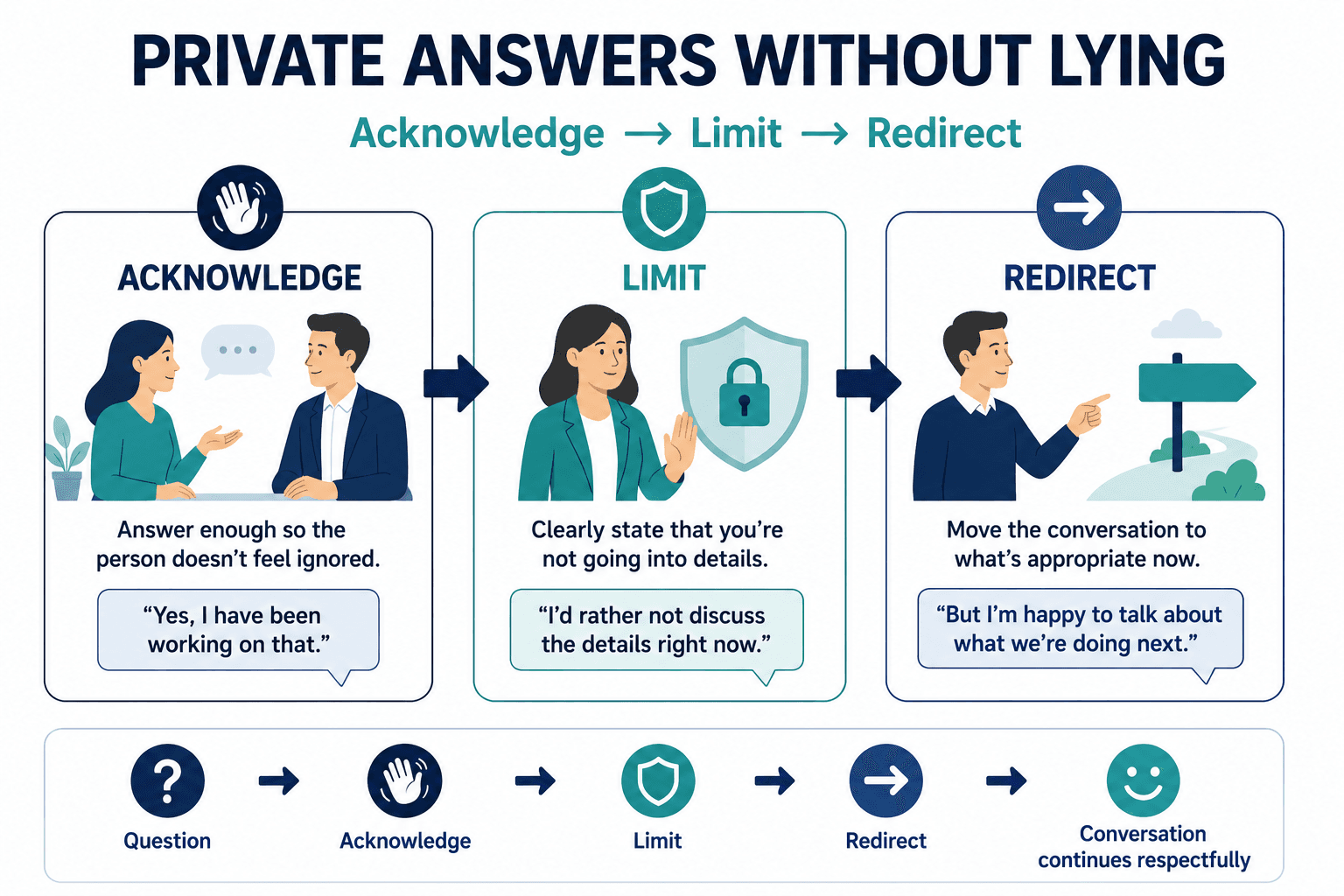
When you do not want to lie but cannot share everything, use a three-part structure: acknowledge, limit, redirect.
Example: “It was a personal situation, so I am keeping the details private. I am focusing on moving forward now.”
Professional reasons you can give
A professional reason does not need to be cold. It simply gives the other person a clear signal that the topic is not open for a detailed discussion.
When a short answer is enough
Not every question deserves the same level of detail. A close friend, a new colleague, a manager, and a curious acquaintance may all ask similar questions, but they do not all need the same answer. The right level of honesty depends on the relationship, the setting, and the purpose of the question.
A short answer is usually enough when the person is asking out of casual curiosity, when the conversation is public, when the details involve other people, or when sharing more would make you feel exposed rather than supported.
Less helpful phrases to avoid
These answers may protect you in the moment, but they can create confusion, invite more questions, or make you feel worse later.
Sometimes a firm boundary is needed, but most everyday conversations go better when your answer is calm, short, and respectful.
Examples you can use
You were fired or pushed out, but you do not want to explain the whole situation casually.
“I left because I wanted a change.”
“It was a difficult ending, and I am keeping the details private. I am focusing on finding a better fit now.”
Someone asks about a mistake, failure, or personal setback you do not want to discuss.
“It was nothing. Everything is fine.”
“It was not my best moment, and I would rather not go into the details. I have learned from it and I am moving forward.”
Someone asks about something that still feels too painful to explain.
“I do not want to talk about it, okay?”
“It is a painful topic for me, so I am not going to discuss the details. Thank you for understanding.”
The real story includes another person’s private behaviour or conflict.
“I cannot say, but they know what they did.”
“Other people are involved, so I do not want to tell the story in a one-sided way. I am keeping it private.”
You already gave a short answer, but the person asks for more details.
“Why do you need to know?”
“I understand you are curious, but I am not comfortable sharing more than that.”
How to sound honest without inviting more questions
The way you end your answer matters. If your voice rises, your sentence trails off, or you add too many explanations, the other person may hear uncertainty and keep asking. A complete sentence with a calm ending often makes the boundary easier to accept.
Try to avoid ending with phrases like “if that makes sense”, “sorry”, or “I know that sounds weird”. Those phrases can make a reasonable boundary sound like something you need permission for. Instead, finish with a steady redirect.
“Why did you leave your last job so suddenly?”
“Oh, I just wanted something new. It was completely fine.”
“It was a difficult situation, and I would rather keep the details private. What I can say is that I am focused on building a healthier next step.”
This answer does not lie, but it also does not turn a casual question into a full personal disclosure.
How to avoid oversharing under pressure
People often overshare because silence feels awkward. If you are nervous, you may keep talking until you accidentally reveal more than you intended. Prepare one or two short lines before you need them.
You can be warm and still be private. A soft tone does not mean your boundary is weak.
How Spekero can help
You can use Spekero to practise saying private answers out loud before someone asks in real life. Record a short answer, listen back, and check whether you sound calm, defensive, apologetic, or clear.
Try practising phrases like “I would rather keep that private” and “I am focusing on what comes next.” The goal is not to sound scripted. The goal is to make the boundary feel easier to say when you are under pressure.
This article is general communication guidance. If the situation involves legal, HR, medical, safety, or serious trauma concerns, speak with the appropriate professional or support service.
Final thought
You can tell the truth without telling everything. A private answer can still be honest when it is clear, respectful, and not designed to mislead.
The right words give you room to protect your dignity, your healing, and your professional relationships at the same time.
Listen to the audiobook
If the video does not load, watch it on YouTube.
References
- Harvard Business Review (2021) How to set healthy boundaries at work. Available at: https://hbr.org.
- MindTools (n.d.) Assertiveness. Available at: https://www.mindtools.com.
- Verywell Mind (2024) How to set boundaries. Available at: https://www.verywellmind.com.
- Center for Creative Leadership (n.d.) Better conversations and active listening. Available at: https://www.ccl.org.