

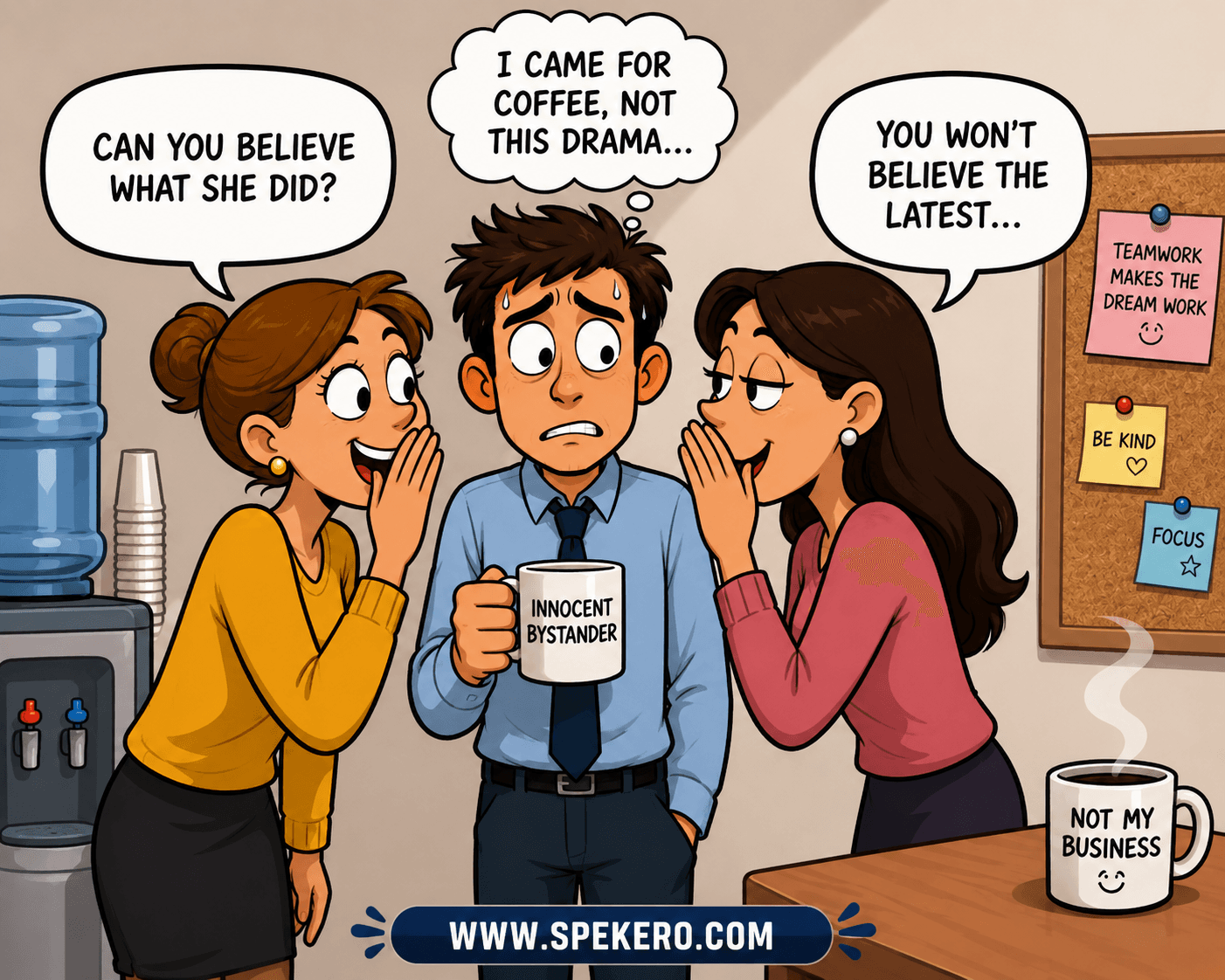
Witnessing a tense moment at work, in a group, or in public can make people feel pressured to explain what happened quickly. The problem is that quick explanations often mix facts with opinions, guesses, emotions, and second-hand details.
A clear witness account is not about sounding dramatic or taking a side. It is about saying what you directly saw or heard, and being honest about what you do not know.
Clear speaking protects fairness, credibility, and trust.
Why people accidentally add opinions
People often add opinions after witnessing something because the brain tries to make a complete story. If someone looked angry, walked away, laughed, or spoke sharply, it is tempting to fill in the reason.
This is human, but it can create problems. Once an assumption is spoken confidently, other people may repeat it as if it were proven.
Facts vs assumptions
A fact is something you directly saw, heard, or can point to. An observation is your plain description of that fact. An opinion is your personal judgement. An assumption is a guess that fills in missing information. A motive is the reason someone acted, and you usually cannot know that unless they clearly said it.
More reliable wording
Less reliable wording
A useful test is simple: could someone else have seen or heard the same thing, or are you adding your interpretation?
Why you should not guess someone’s intention
Intention is difficult to know from the outside. Someone may sound rude because they are angry, nervous, distracted, tired, or unaware of their tone. You can describe the words and behaviour, but you should be careful about saying what someone meant unless they said it clearly.
Instead of saying, “He definitely meant to embarrass her,” a fairer version is, “He laughed after she answered, and she looked uncomfortable.” That gives people useful information without pretending you know the private reason behind it.
Useful phrases to describe what you witnessed
Neutral phrases help you stay accurate without sounding cold or evasive. They also show that you are not gossiping, exaggerating, or trying to control how others judge the situation.
Less helpful phrases to avoid
These phrases sound certain, but they add motives, judgement, or gossip to the account.
Note: The issue is not that these statements are always impossible. The issue is that they go beyond what you directly witnessed.
Practical workplace and social examples
Two colleagues disagree during a team discussion, and one person leaves the room.
“She stormed out because she wanted attention.”
“I saw them leave the room after the disagreement. I do not know why they left.”
A customer speaks loudly at the front desk after waiting for help.
“The customer was trying to cause trouble.”
“The customer raised their voice and said they had been waiting for twenty minutes.”
A colleague tells others that a meeting has been cancelled.
“He was trying to confuse everyone.”
“I heard him say the meeting was cancelled. I do not know where he got that information.”
You hear raised voices from another room but only catch part of the conversation.
“They were clearly fighting about money.”
“I heard raised voices, but I only caught part of the conversation. The part I heard was about the invoice.”
A coworker asks you to explain a tense moment you saw earlier.
“Everyone knows what she’s like, so I’m not surprised.”
“What I personally witnessed was that she interrupted twice and the other person became quiet.”
Example in a real conversation
“Can you tell me what happened after the disagreement in the meeting?”
“He did it on purpose. He was obviously trying to make her look bad.”
“From what I saw, he questioned her answer twice in front of the group. She paused, looked down, and did not answer the second question. I cannot speak for his intention, but that is what I personally witnessed.”
Note: This response is clear without being dramatic. It gives enough detail to be useful while staying away from motive and gossip.
How to stay neutral when you feel emotional
Staying neutral does not mean you have no feelings. It means you do not let those feelings rewrite the facts. If you are upset, pause before explaining the event. Use slower wording, shorter sentences, and clear boundaries around what you know.
You can still mention impact carefully. For example, “She looked uncomfortable” is more grounded than “He wanted to humiliate her.” One describes an observable reaction. The other claims to know a motive.
How Spekero can help
You can use Spekero to practise calm, neutral speaking before a difficult conversation. Record yourself describing a workplace or social situation using only what you saw, heard, and directly observed.
Listen back and check whether you added assumptions, emotional labels, or motives. Then record a cleaner version using phrases like “The part I saw was…” or “I may not know the full context.”
This article is communication guidance, not legal advice. In formal workplace, HR, safety, or legal situations, follow the relevant process and ask the appropriate person for guidance.
Final thought
The most credible person in a tense situation is not always the person with the strongest opinion. It is often the person who can calmly say, “This is what I saw, this is what I heard, and this is what I do not know.”
When you separate facts from assumptions, you make it easier for others to understand what happened without being pushed toward a conclusion you cannot prove.
Listen to the audiobook
If the video does not load, watch it on YouTube.
References
- Harvard Business Review (2020) How to have difficult conversations when you do not like conflict. Available at: https://hbr.org.
- MindTools (n.d.) Active Listening. Available at: https://www.mindtools.com.
- Center for Creative Leadership (n.d.) Use active listening to coach others. Available at: https://www.ccl.org.
- University of California, Berkeley Greater Good Science Center (n.d.) Emotional intelligence. Available at: https://greatergood.berkeley.edu.