
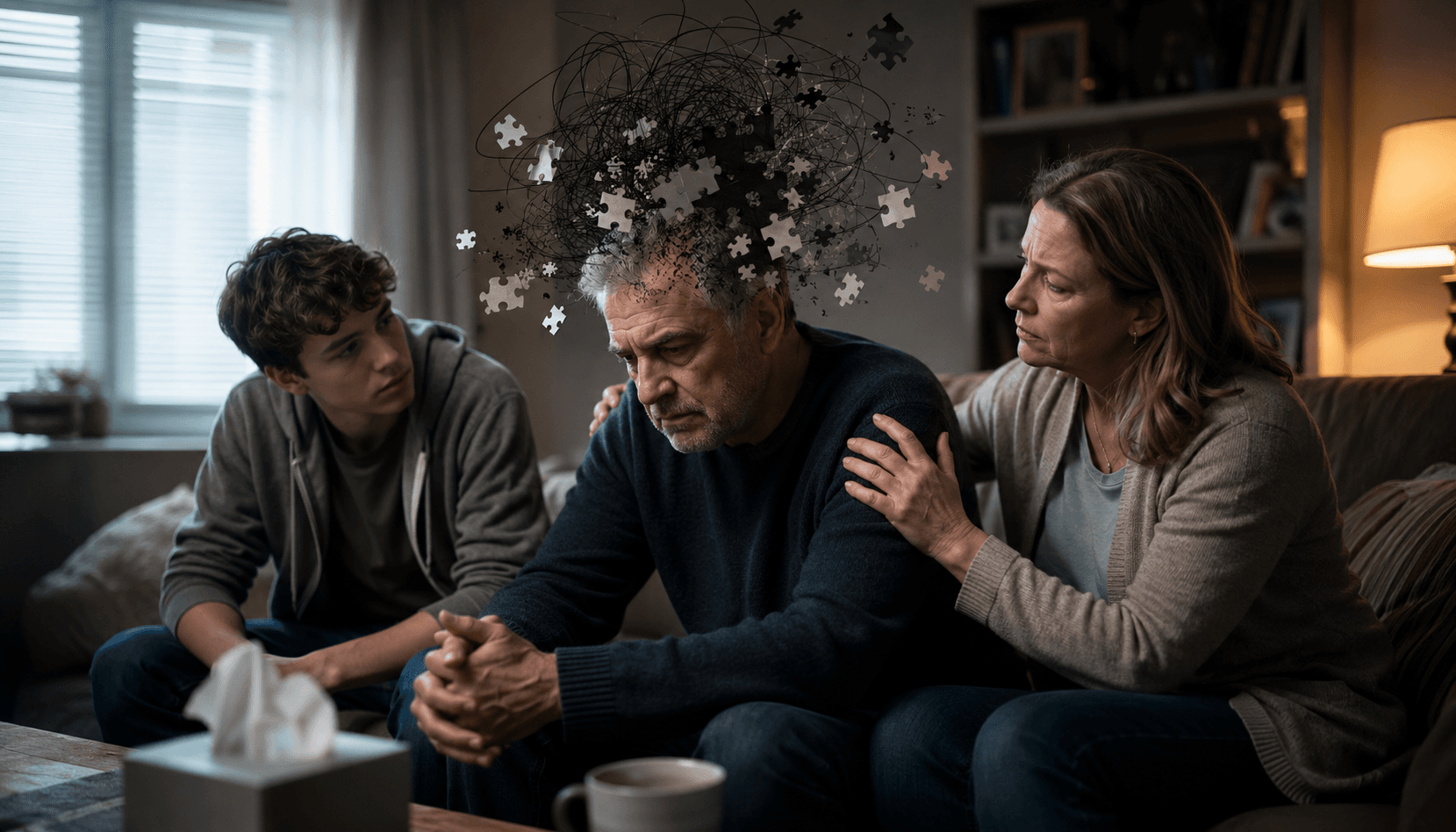
Brain injury can change personality because the brain systems that manage impulse control, emotional regulation, judgement, and empathy may no longer work in the same way. A person may still remember facts, speak clearly, and recognise loved ones, yet struggle to pause before reacting, understand another person's feelings, or recover from frustration.
This is one of the hardest realities for families, friends, colleagues, and carers to understand. The person may look familiar. Their voice may sound the same. But conversations can feel different, sharper, colder, more impulsive, or more unpredictable. Understanding the brain does not erase the pain, but it can reduce confusion and help people communicate more safely.
A changed brain can change behaviour. That explains some reactions, but it does not mean every hurtful action has to be accepted without limits.
The Person Is Still There, So Why Do They Feel Different?
Imagine someone survives a serious accident, stroke, infection, tumour, or other brain injury. Everyone is relieved they are alive. Slowly, though, people around them begin to notice something more complicated than physical recovery.
They interrupt more. They become angry over small delays. They say things that sound selfish or cruel. They do not seem to notice when someone else is tired, embarrassed, or upset. A family member may quietly think, "This is not the same person I knew."
That sentence is emotionally heavy, and it is not always accurate in a simple way. The person has not been replaced. But some of the brain circuits that helped them organise behaviour, filter words, control impulses, and read social situations may have been disrupted. The result can feel like a personality change, even when the person's history, memories, and identity are still present.
The Brain Has a CEO, and Sometimes the CEO Gets Injured
One simple way to understand this is to imagine the brain as a company. The frontal areas of the brain are a bit like the senior leadership team. They help with planning, judgement, impulse control, self-awareness, emotional brakes, and social decision-making.
When this "CEO system" is working well, it does not remove emotion. It helps the person choose what to do with emotion. Someone may feel irritated but still wait. They may think of a sarcastic comment but decide not to say it. They may disagree without humiliating the other person.
After a brain injury, that pause can become weaker. The emotional reaction may still arrive, but the system that normally checks it may be slower, tired, or unreliable. This is why a person can seem intelligent in one moment and shockingly impulsive in the next.
Related article: If you want a broader explanation of emotional pauses in everyday speech, read what it really means to have good self-control.
Why Intelligence Does Not Always Protect Communication
A person can still be clever after a brain injury and still struggle socially. They may solve problems, remember names, drive, work, or hold long conversations, but become less able to manage anger, understand sarcasm, notice a bored listener, or predict how a sentence will land.
Intelligence and regulation are not the same skill. Knowledge answers the question, "Can this person understand information?" Regulation answers, "Can this person use that information calmly while emotion, fatigue, pressure, or frustration is present?" Those are different brain demands.
That difference explains why conversations can be confusing for families. Someone may sound completely reasonable while discussing the news, then explode because a plan changed. The issue is not always lack of knowledge. Sometimes it is a damaged ability to pause, shift, adapt, and choose the next sentence.
Why Anger, Impulses, and Empathy Can Change
Emotions can become faster after brain injury because the alarm systems of the brain may be less balanced by the areas that normally slow things down. In everyday life, that can look like anger arriving before thought has caught up.
Picture a queue. Someone steps in front. A healthy response might be: notice the irritation, pause, decide whether it matters, then either ignore it or speak calmly. With weaker impulse control, the middle step may collapse. The person may shout before they have fully judged the situation.
Empathy can also change. Empathy is not only kindness; it is a complex ability to notice another person's emotional state, imagine their experience, and adjust your own behaviour. If attention, emotional reading, or inhibition is affected, a person may seem less caring even when they are not consciously trying to be cruel.
This is why some people after brain injury become unusually blunt, suspicious, child-like, socially inappropriate, impatient, or emotionally flat. Others may become tearful, anxious, easily overwhelmed, or exhausted by ordinary conversation. Brain injury does not create one single personality pattern. It changes the systems that help personality show itself in stable ways.
When They Say Hurtful Things, Do They Mean Them?
This question is painful because the answer is rarely simple. Sometimes a hurtful sentence reflects a real feeling that came out without enough filtering. Sometimes it is a flash of frustration that the person would not have chosen before the injury. Sometimes it is part of a repeated harmful pattern that needs stronger boundaries and outside support.
The most useful distinction is this: understanding the cause should guide the response, not remove every limit. It may be true that the person's brain is making emotional control harder. It can also be true that other people need protection from insults, threats, intimidation, or repeated hurtful behaviour.
Instead of asking only, "Did they mean it?" also ask, "What support, structure, treatment, boundaries, and safety plans are needed now?" That question is more practical, and it avoids trapping everyone in blame or denial.
Could a Toxic Person Have Something Going on in the Brain?
It is natural to wonder whether a toxic boss, colleague, classmate, friend, or family member is acting that way because something deeper is happening in the brain. Maybe their anger feels extreme. Maybe their empathy seems unusually low. Maybe their reactions feel far beyond the situation in front of them.
Still, we cannot know from behaviour alone whether someone has a brain injury, neurological condition, trauma history, personality pattern, stress problem, or simply a harmful habit. That kind of conclusion belongs with qualified health professionals, proper assessment, and medical evidence. A brain scan or clinical evaluation may explain some changes, but guessing can easily become unfair or misleading.
What we can do is notice when behaviour does not seem normal, safe, or respectful. Awareness helps because it shifts the question from "How do I make them become a different person?" to "What response protects my safety, dignity, and self-control?" Sometimes that means using calmer wording. Sometimes it means reducing contact. Sometimes it means leaving the workplace, friendship, classroom group, or family situation as much as realistically possible. If the issue is happening with someone who talks down to you, practise responding to condescending speech.
You may not be able to change the other person's brain, habits, or choices. You can only look after your own behaviour, your own boundaries, and the support you seek. That is not weakness. It is often the most realistic form of control you have.
Can Toxic Words Harm the Listener's Brain?
Toxic words are not harmless just because they leave no bruise. Studies on verbal abuse, social rejection, workplace bullying, and chronic stress all point in the same general direction: repeated emotional threat can affect how people feel, concentrate, sleep, trust others, and regulate stress.
Research on childhood verbal abuse has linked repeated harsh verbal aggression with mental health risks and differences in brain pathways involved in language and emotional processing. This does not mean every argument causes brain damage. It means that repeated verbal threat, especially during development, can become a real biological stressor rather than "just words."
Social rejection research also shows why humiliating, excluding, or shaming people can feel physically painful. Brain imaging studies suggest that social pain and physical pain can involve overlapping distress systems. Later research has debated exactly how similar those systems are, but the practical lesson is still important: humans are wired to experience social threat as something serious.
Chronic stress research gives another useful clue. Long-term stress can affect brain regions involved in memory, threat detection, and self-control, including the hippocampus, amygdala, and prefrontal cortex. Workplace bullying studies also link repeated bullying with higher job stress and poorer wellbeing. In plain language, a toxic environment can keep the listener's body and brain in a state of alert.
So can toxic behaviour lead to brain damage? It is more accurate to say this: repeated verbal abuse, bullying, humiliation, and chronic emotional threat can contribute to stress-related changes and mental health harm, and some research has found measurable brain differences after severe or repeated abuse. But no one should diagnose brain damage from ordinary conflict, one cruel sentence, or a bad workplace week. Duration, intensity, age, vulnerability, support, and safety all matter.
This is why boundaries matter. If someone's words repeatedly make you feel unsafe, small, panicked, or constantly on guard, the goal is not to prove what is happening inside their brain. The goal is to protect your own nervous system: document what happens, seek support, reduce exposure where possible, and leave when the situation is harming you and you have a realistic way out.
The Domino Effect: How Toxic Behaviour Spreads
Toxic behaviour can create a domino effect. One person's shouting, humiliation, sarcasm, threats, or constant criticism does not stay inside one conversation. It changes the emotional weather around them. Other people become guarded, tense, defensive, or afraid of making mistakes.
Over time, some listeners start copying the same behaviour. A colleague who is regularly spoken to with contempt may begin speaking sharply to someone with less power. A child who grows up around insults may learn that insults are how conflict is handled. A team that is managed through fear may become less honest, less kind, and more likely to blame each other.
This does not mean harm excuses harm. Being exposed to toxic behaviour can explain why someone becomes more reactive, suspicious, or defensive, but it does not remove their responsibility to notice the pattern and stop passing it on. Pain can become a reason to get support. It should not become a licence to damage the next person.
The healthiest interruption is often one person choosing not to continue the chain. That may mean pausing before replying, refusing to copy the same tone, documenting repeated behaviour, asking for help, or stepping away from the environment. You may not be able to stop the first domino from falling, but you can sometimes stop it from falling through you.
How to Communicate Without Making Things Worse
Communication after brain injury often works better when it is calm, concrete, and paced. Long explanations, emotional lectures, sarcasm, and rapid correction can overload a person whose processing and regulation are already under strain.
- Use one clear idea at a time.
- Lower the emotional temperature before explaining facts.
- Give extra time for the person to process and answer.
- Offer simple choices instead of long instructions.
- Set boundaries when words or behaviour become unsafe.
The goal is not to treat the person like a child. The goal is to reduce unnecessary load. If someone is already struggling to regulate emotion, a ten-point explanation may feel like pressure, even when it is reasonable.
Related article: For a similar skill in tense conversations, read how to deal with demanding people without losing self-control.
Real Situations and Better Phrases
When anger arrives too fast
Situation: A family member becomes furious because dinner is late, even though the delay is small.
Less effective: "You are overreacting again. This is ridiculous."
Better: "I can see this feels frustrating. Dinner is running late, and it will be ready in ten minutes. I am going to keep the conversation calm."
- It names the emotion without agreeing that the reaction is fair.
- It gives one concrete fact instead of a long defence.
- It keeps a boundary around tone and safety.
When logic does not work immediately
Situation: A colleague with a brain injury misunderstands a change in schedule and insists everyone is against them.
Less effective: "That makes no sense. Nobody said that."
Better: "The schedule changed, and I can see it feels sudden. Let us look at the new plan together, one part at a time."
- It avoids arguing with the emotional reaction first.
- It gives structure to reduce overload.
- It moves the conversation toward the next useful action.
When hurtful words appear
Situation: Someone says something cruel and later acts as if it was not serious.
Less effective: "So you clearly meant to hurt me."
Better: "That comment hurt. I understand things may come out faster now, but I am not willing to be spoken to that way."
- It separates possible brain-related impulsivity from the real impact.
- It explains the boundary without shaming the person.
- It makes clear that compassion does not mean accepting abuse.
When you want to model calmer speech
Situation: Someone speaks sharply again, and you want to respond without copying their tone or taking every word personally.
Less effective: "Fine, if you are going to be rude, I will be rude too."
Better: "I am going to take a breath before I answer. I want to understand you, and I would appreciate it if you could say that again in a calmer voice."
- It gives your own nervous system a moment to settle before replying.
- It models the tone you want instead of mirroring the hurtful behaviour.
- It repeats a simple expectation the person may learn from over time, while still protecting your boundary.
Calm repetition matters. If the person is able to learn from feedback, hearing the same respectful boundary many times can sometimes become part of a new pattern: speak more calmly, get a calmer conversation. This is not guaranteed, and it should not be used to excuse ongoing harm. But when the situation is safe enough, your steady voice can become a model of the behaviour you are asking for.
Hope Does Not Mean Pretending Nothing Changed
The brain can learn. Many people improve with time, rehabilitation, routines, therapy, rest, medication when appropriate, environmental changes, and patient communication practice. Neuroplasticity means the nervous system can adapt, but it does not mean recovery is instant or guaranteed.
Hope is most useful when it is honest. Some changes may soften. Some may need long term support. Some families may need professional guidance to stay safe and steady. If behaviour becomes threatening, violent, or impossible to manage, it is important to involve medical, mental health, safeguarding, or emergency support rather than trying to solve everything through better wording.
Related articles: how to respond when a question makes you feel defensive, how to speak without escalating outbursts, and how to respond when people talk down to you.
Final Thoughts
Maybe the person you knew is not gone. Maybe they are still there, but reaching you through a brain that now filters emotion, impulse, attention, and empathy differently. That understanding does not make the situation easy. It does not make hurtful behaviour harmless. But it can replace some confusion with a clearer map.
Better communication after brain injury is not about finding one perfect sentence. It is about combining compassion with structure, patience with limits, and hope with realism. That balance gives everyone a better chance of staying connected without ignoring the real impact of what has changed.
Practice with Spekero
Practise one calm sentence before a difficult conversation. Record yourself saying it three ways: rushed, too emotional, and steady. Listen for pace, blame, clarity, and whether the sentence gives one simple next step.
Start practisingListen to the audiobook
Listen to the full audiobook version of this article and follow the ideas at a calm, reflective pace.
References
- Model Systems Knowledge Translation Center. Behavior Changes After Traumatic Brain Injury (TBI). Available at: https://msktc.org/tbi/factsheets/understanding-behavior-changes-after-tbi.
- BrainLine. Behavioral & Emotional Symptoms. Available at: https://www.brainline.org/topic/behavioral-emotional-symptoms.
- Brain Injury Association of America. Coping With Behavior Problems After Brain Injury. Available at: https://biausa.org/public-affairs/media/coping-with-behavior-problems-after-brain-injury.
- Headway. Behavioural effects of brain injury. Available at: https://www.headway.org.uk/about-brain-injury/individuals/effects-of-brain-injury/behavioural-effects-of-brain-injury/.
- Mayo Clinic. Traumatic brain injury: Symptoms and causes. Available at: https://www.mayoclinic.org/diseases-conditions/traumatic-brain-injury/symptoms-causes/syc-20378557.
- National Institute of Neurological Disorders and Stroke. Traumatic Brain Injury. Available at: https://www.ninds.nih.gov/health-information/disorders/traumatic-brain-injury-tbi.
- Kolb, B. and Gibb, R. (2011) Brain plasticity and behaviour in the developing brain. Journal of the Canadian Academy of Child and Adolescent Psychiatry. Available at: https://pmc.ncbi.nlm.nih.gov/articles/PMC3222570/.
- Choi, J., Jeong, B., Rohan, M. L., Polcari, A. M. and Teicher, M. H. (2009) Preliminary evidence for white matter tract abnormalities in young adults exposed to parental verbal abuse. Biological Psychiatry. Available at: https://pmc.ncbi.nlm.nih.gov/articles/PMC2950228/.
- Eisenberger, N. I. (2012) The neural bases of social pain: Evidence for shared representations with physical pain. Psychosomatic Medicine. Available at: https://pmc.ncbi.nlm.nih.gov/articles/PMC3273616/.
- McEwen, B. S., Nasca, C. and Gray, J. D. (2015) Stress Effects on Neuronal Structure: Hippocampus, Amygdala, and Prefrontal Cortex. Neuropsychopharmacology. Available at: https://www.nature.com/articles/npp2015171.
- Lee, J. and Lim, J. J. (2024) Association between Workplace Bullying, Job Stress, and Professional Quality of Life: A Systematic Review and Meta-Analysis. Healthcare. Available at: https://pmc.ncbi.nlm.nih.gov/articles/PMC10970563/.