
When people talk about being a good speaker, they often think about confidence, vocabulary, humour, or sounding clever. Those things can help, but they are not enough. A person can sound confident and still be exhausting to speak with. A person can know many facts and still make others feel small.
A good speaker is not simply someone who talks well. A good speaker helps the conversation work. They know when to explain, when to ask, when to listen, when to stop, and when to make space for another person's experience.
The best speakers do not dominate the room. They help the room breathe.
What makes a speaker good?
Good speakers are usually easy to talk to because they notice the other person. They can tell when someone is interested, confused, quiet, rushed, or uncomfortable. They do not keep pushing the same style of speaking regardless of the response they are getting.
This does not mean they are passive. Good speakers can still be funny, direct, expressive, and knowledgeable. The important part is balance. They add something to the conversation without taking ownership of the whole thing.
The balanced speaker
They share enough to be interesting, then make room for the other person. They do not treat every pause as a stage to fill.
The curious listener
They ask questions because they want to understand, not because they are collecting details to judge or correct later.
The clear speaker
They explain their point in a simple order, check whether it makes sense, and avoid adding ten extra stories at once.
The encouraging speaker
They help others feel safe to continue. Their tone says, I am with you, not I am waiting to catch you out.
Good speakers make other people visible
A helpful speaker does not only wait for their turn. They listen for meaning. They might say, "So the difficult part was not only what happened, but that nobody took it seriously?" That kind of response shows attention. It also helps the other person feel understood without needing to repeat the story again and again.
Good speakers also ask questions that are easy to answer. They do not ask five questions at once, turn the person into an interview subject, or use questions to prove a point. A good question opens the conversation. A bad question corners it.
Speaker types that people often find annoying
Annoying speaking habits are not always caused by bad intentions. Some people interrupt because they are excited. Some explain too much because they want to be useful. Some correct others because accuracy matters to them. The problem is the effect: the other person starts to feel unseen, judged, or blocked.
The know-it-all
Common habit
They correct small details, add unnecessary facts, or act as if every conversation is a test they must win.
Better direction
Add knowledge only when it helps the conversation, and use softer phrases such as, I might be wrong, but I have heard it this way.
The conversation stopper
Common habit
They reply with dead-end phrases such as okay, anyway, whatever, or that is obvious, which gives the other person nowhere to go.
Better direction
If you do not want to continue, close kindly. If you do want to continue, add one small question or comment.
The interrupter
Common habit
They jump in before the other person finishes, often because they are excited, impatient, or worried they will forget their point.
Better direction
Let the person finish one complete thought, then respond to what they actually said before adding your own idea.
The one-upper
Common habit
They turn someone else's story into a bigger story about themselves. The other person may feel erased instead of understood.
Better direction
Acknowledge the person's moment first. If your own story is useful, share it after you have shown that you heard theirs.
The endless lecturer
Common habit
They explain for too long without noticing that the other person has stopped engaging.
Better direction
Pause after the main point and ask, Does that answer it, or should I explain one part more clearly?
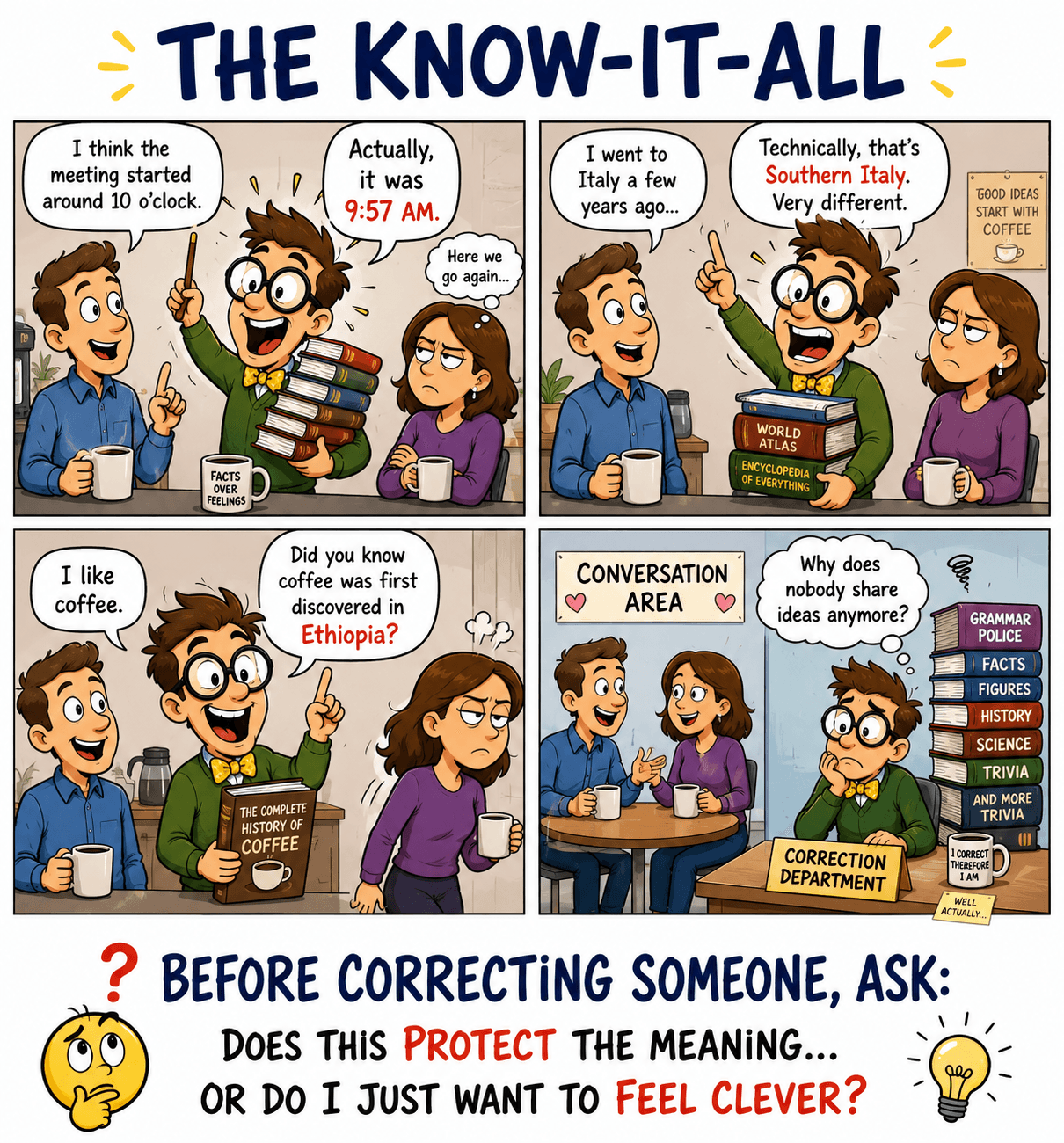
The know-it-all problem
The know-it-all is not annoying because they know things. People often enjoy talking to someone knowledgeable. The problem starts when knowledge becomes a performance of superiority. If every small mistake is corrected, every story is improved, and every opinion is turned into a lecture, the conversation stops feeling mutual.
A know-it-all may think, "I am just being accurate." But the listener may hear, "You are not smart enough to speak freely around me." Over time, people may stop sharing ideas because they do not want every sentence examined.
Before correcting someone, ask yourself: does this detail protect the meaning, or am I correcting it because I want to feel clever?
The conversation stopper problem
A conversation stopper shuts down momentum. Sometimes they do it with one-word replies. Sometimes they do it with a judgement that makes the other person feel foolish: "That is boring," "Why would you care about that?" or "Everyone knows that already."
Of course, nobody has to continue every topic forever. You are allowed to be tired, busy, or uninterested. The skill is to exit without making the other person feel ridiculous for trying to connect. A warmer close might be, "I do not know much about that, but I can see you are into it," or "I need to get back to work, but tell me the main part before I go."
Examples: less effective and better
When you know the correct answer
Situation
Someone says a small fact wrong, but correcting it is not important to the main conversation.
Less effective
"Actually, that is wrong. Everyone knows it happened in a different year."
Better
"I think the date might be different, but your main point makes sense."
Why this works
When you are losing interest
Situation
The topic is not interesting to you, but the other person is still speaking with energy.
Less effective
"Yeah. Anyway."
Better
"I may not know much about this topic, but what made you interested in it?"
Why this works
When you interrupted
Situation
You jumped in too quickly and noticed the other person had not finished.
Less effective
"Sorry, but I just need to say this quickly."
Better
"Sorry, I cut you off. Finish your thought first, then I will add mine."
Why this works
How to tell which type you are becoming
Most people move between different speaker types depending on mood, confidence, stress, and who they are with. You might be a balanced speaker with friends but become a lecturer at work. You might be curious with strangers but interrupt family because you feel too comfortable. The goal is not to label yourself forever. The goal is to notice your current habit.
How to become easier to talk to
You do not need to become quiet or agreeable to be a better speaker. You need to become more responsive. Responsive speakers adjust. They notice when a point has landed, when a topic needs a question, when someone wants encouragement, and when the conversation needs a clean ending.
Try the two-turn rule: after you make a point, give the other person a real chance to respond before adding another point. If you are explaining something complex, pause and check whether they want more detail. If you disagree, respond to their actual meaning before giving your correction.
A useful phrase is: "I have a different thought, but I want to make sure I understood you first."
How Spekero can help you practise
You can use Spekero to record short conversation responses and listen back for tone, pace, and balance. Try recording a know-it-all version first: correct, explain, and add too much detail. Then record a better version where you acknowledge the person, add only the useful point, and ask one open question.
Listening back helps because many annoying habits are easier to hear from the outside. You may notice that your correction sounds sharper than you intended, or that your "quick explanation" is much longer than the other person needed.
Final thought
The most likeable speaker is not always the funniest, smartest, or loudest person in the room. Often, it is the person who makes talking feel easy. They know when to share and when to listen. They can be interesting without taking over. They can be correct without making others feel foolish.
If you want to become a better speaker, start by noticing the effect you have on the conversation. When people leave a conversation feeling respected, included, and free to speak, your speaking style is doing something right.
Related articles: different tones of speaking and why being a good listener can help you become a better speaker.
Listen to the audiobook
If the video does not load, watch it on YouTube.
References
- Harvard Business School (n.d.) Questioning, Listening & Responding. Available at: https://www.hbs.edu/teaching/case-method/leading-in-the-classroom/Pages/questioning-listening-responding.aspx.
- Harvard Office of the Vice Provost for Advances in Learning (n.d.) Cultivating the skill and the orientation to listen. Available at: https://www.vpal.harvard.edu/activelistening.
- Stanford Report (2018) Exploring what an interruption is in conversation. Available at: https://news.stanford.edu/2018/05/02/exploring-interruption-conversation/.
- Vangelisti, A. L., Knapp, M. L. and Daly, J. A. (1990) Conversational narcissism. Communication Monographs, 57(4), 251-274. Available at: https://www.tandfonline.com/doi/abs/10.1080/03637759009376202.